
Skip to content
Home » Blog » How to Adjust the Height of Your Bicycle Seat

How to Adjust the Height of Your Bicycle Seat

How to Adjust the Height of Your Bicycle Seat

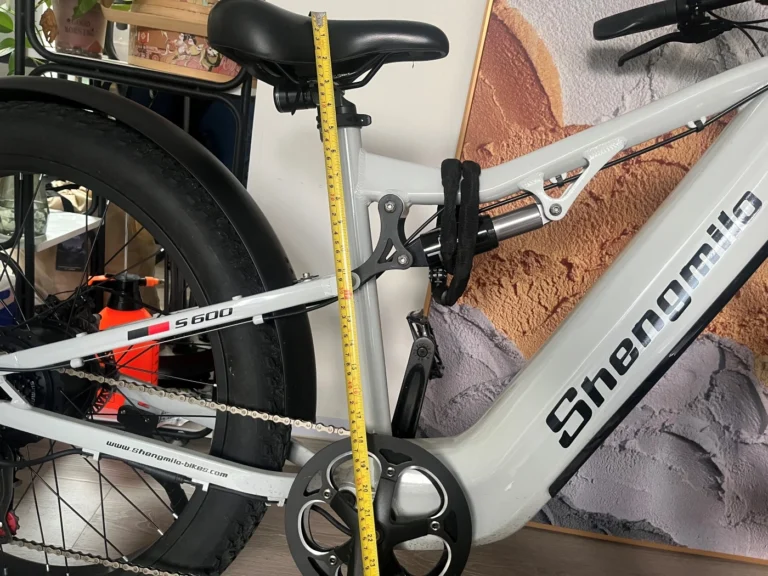
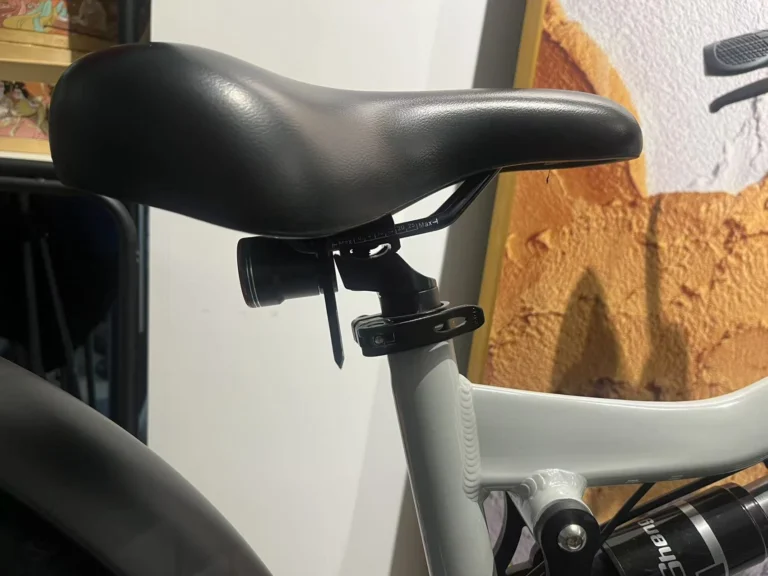
Adjusting the saddle height on Shengmilo S600 electric bike, measured from the bottom bracket
The saddle height is typically adjusted by measuring from the bottom bracket of the frame.

Adjusting the saddle height is one of the most important changes you can make to improve your cycling fit.

In this guide, we’ll show you how to find the correct saddle height on your bike, as well as how to adjust the saddle’s forward/backward position and tilt angle.

While this guide focuses on road bikes, the principles apply equally to mountain bikes, electric bikes, and gravel bikes.

When your saddle is set at the correct height, in the right forward/backward position, and at the proper angle, you’ll enjoy a comfortable and efficient riding experience.

Failing to make these adjustments can lead to discomfort and even injury. Many common pain issues are linked to improper saddle height before cycling.

How to Adjust Your Bicycle Saddle Height

Before making any adjustments, it’s important to record your initial saddle position. This will help you later, especially if your adjustments don’t work out—knowing your starting point allows you to easily revert to it.

In addition to saddle height, you should also consider the saddle’s fore/aft position and tilt angle.

1. Measuring Saddle Height

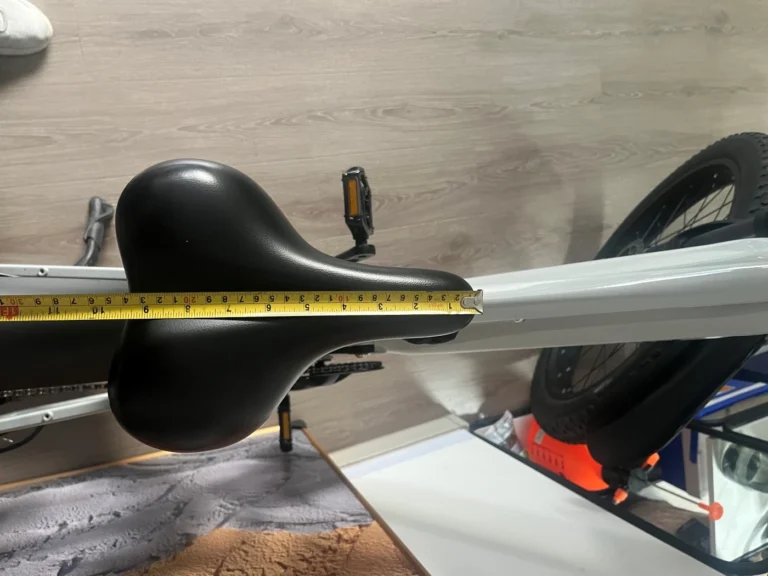
Measuring the length of the Shengmilo S600 e-bike saddle from front to back to find the midpoint
Measure the length of the saddle from front to back to find the midpoint.

First, measure the length of the saddle from front to back and find its midpoint. Mark this point.

Using a measuring tape, measure straight down from the center of the saddle to the center of the bottom bracket.

Record the closest measurement (for example, 764mm).

2. Measuring the Saddle’s Fore/Aft Position

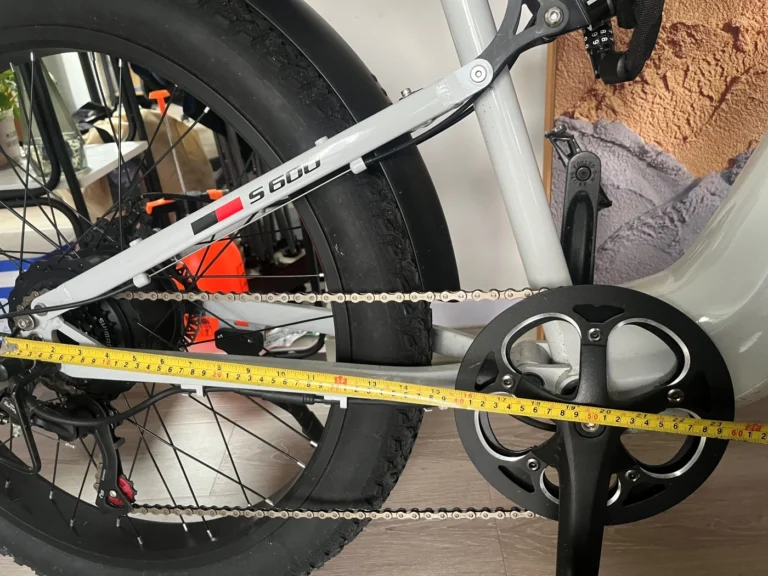
Measuring the horizontal distance from the rear axle to the bottom bracket of the Shengmilo S600 e-bike frame
Measure the horizontal distance from the rear axle to the bottom bracket of the frame.

Lean the bike against a wall or place it on a stationary trainer, ensuring it is vertical.

Measure the distance from the wall to the bottom of the bike frame (Measurement 1) and the distance from the wall to the top of the saddle (Measurement 2).

To find the saddle’s rearward movement distance, subtract Measurement 1 from Measurement 2.

3. Measuring the Saddle’s Tilt Angle

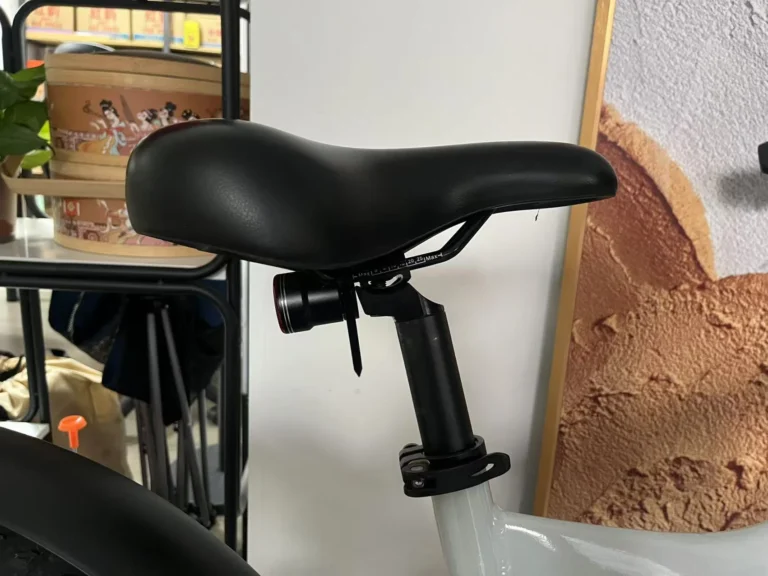
Shengmilo S600 e-bike showing saddle angle measurement process with level alignment
Before measuring the saddle angle, make sure your bike is in a level position.

Since many saddles have unique shapes, it’s best to measure the overall tilt. Aim for accuracy to the nearest degree (1°/10).

Finding the Perfect Saddle Height

Once you’ve completed the three measurements, you can start adjusting.

Use the Heel Method for Saddle Height

Rider on Shengmilo S600 e-bike showing flat heel position for correct saddle height
A flat heel position on the pedal indicates that your saddle height is generally appropriate.

The “Heel Method” is a quick way to establish a baseline saddle height. This can be done at your doorstep or preferably on a stationary trainer.

Put on the shoes you plan to ride in and mount the bike, placing your heels on the pedals. Slowly pedal forward and backward. If the saddle is too high, you’ll struggle to pedal smoothly, having to rock your hips to extend your legs.

Lower the saddle by 1-2 centimeters each time until this issue is resolved. Conversely, if you can pedal smoothly, try raising the saddle a few centimeters until you feel the need to stretch your legs. Then, adjust the saddle backward until you can pedal comfortably without forcing your legs.

How to Use Your Smartphone Camera to Determine Saddle Height

Asking for help to record or take photos of your pedaling position on the trainer with Shengmilo S600 e-bike
Ask someone to help record or take photos of your pedaling position on the trainer.

You can ask someone to use a smartphone camera to record your riding position, which will help determine your saddle height by capturing the angle of your knee flexion. Alternatively, you can use a stationary trainer and support yourself with one hand against a wall.

First, position your feet on the pedals as you would while riding. If you use clipless pedals, engage them for measurement. If you prefer flat pedals, place about one-third of each foot over the front of the pedal axle and two-thirds over the back.

Shengmilo Bike rider showing ideal posture on the bike for an optimal riding experience
When the pedal is at its lowest point, your knee should be bent at approximately 25-30°

When the pedal is at its lowest point (around 5 o’clock, not 6 o’clock), your knee should be flexed between 30° and 40°.

  • If the image shows your knee angle is less than 30°, your saddle may be too low, leading to tightness in the front of your knee or excessive strain on your quadriceps.
Shengmilo Bike rider showing ideal posture on the bike for an optimal riding experience
When the pedal is at its lowest point, your knee should be bent at approximately 25-30°
  • If the knee angle is greater than 40°, the saddle may be too high, which can cause discomfort in your lower back.

Continue adjusting the saddle height until you find a position that feels smooth and balanced.

Now take your bike for a ride outdoors, bringing along an Allen wrench or a portable tool kit for any necessary adjustments.

Using Formulas to Adjust Saddle Height

Comparison of Hamley and LeMond methods for adjusting crank length on Shengmilo e-bike
The Hamley method takes crank length into greater consideration compared to the LeMond method.
  • Two common measurement methods for determining saddle height are based on your inseam length:

    1. LeMond Method: Multiply your inseam length (in mm) by 0.883. This value gives you the distance from the top of the saddle to the bottom bracket, but does not account for crank length.
    2. Hamley Method: Multiply your inseam length (in mm) by 1.09. This gives you the distance from the top of the saddle to the center of the pedal axle in the 6 o’clock position.

    Achieving the Perfect Saddle Tilt

    Your saddle should properly support your sit bones (ischial tuberosities). While sitting on the saddle, if you feel your sit bones aren’t supported, it could be for one of two reasons:

    1. The saddle shape/width doesn’t match your body structure.
    2. The saddle tilt isn’t providing proper support for your sit bones.

    For the first case, check if your saddle fits you properly. If the tilt is fine (ensuring pressure is applied correctly to the pelvis), then the saddle may simply be the wrong fit. If the front of the saddle is too high, it can make it difficult for your sit bones to provide support.

Shengmilo e-bike showing saddle too tilted forward, which may cause rider to slide forward
If the saddle is too tilted forward, it may cause you to slide forward.

Conversely, if the saddle is too tilted forward, your sit bones may feel supported, but you might slide forward, causing pressure on your hands.

Use a flat board and a level (or a smartphone app) to measure the saddle’s tilt and record the angle. Ensure your bike is level; if it can’t maintain that position, adjust accordingly to support your hips properly. Most saddles should be tilted between 0° and 6°.

How to Know if Your Saddle Height is Correct

The correct saddle height should provide:

  • Feet in a horizontal position without excessive downward tilt of toes or heels.
  • Stable pelvis without lateral rocking; excessive rocking often indicates the saddle is too high.
  • Consistent saddle position; incorrect height can cause the rider to shift back and forth on the saddle.
  • Stable pedal stroke without feeling like your feet are about to leave the pedals.
  • No discomfort, especially around the knees.
  • Even muscle load distribution.

If adjusting the saddle height doesn’t yield these results, check the height of your handlebars and the positioning of your cleats for further adjustments.


Shengmilo S600 e-bike with saddle in optimal position for efficient and comfortable riding
You will be able to ride efficiently and comfortably when your saddle is in the optimal position.
Share the Post:

Related Posts

Join Our Newsletter

Holiday Mega Sale! Black Friday + Christmas Deals Are Live — Shop Now!